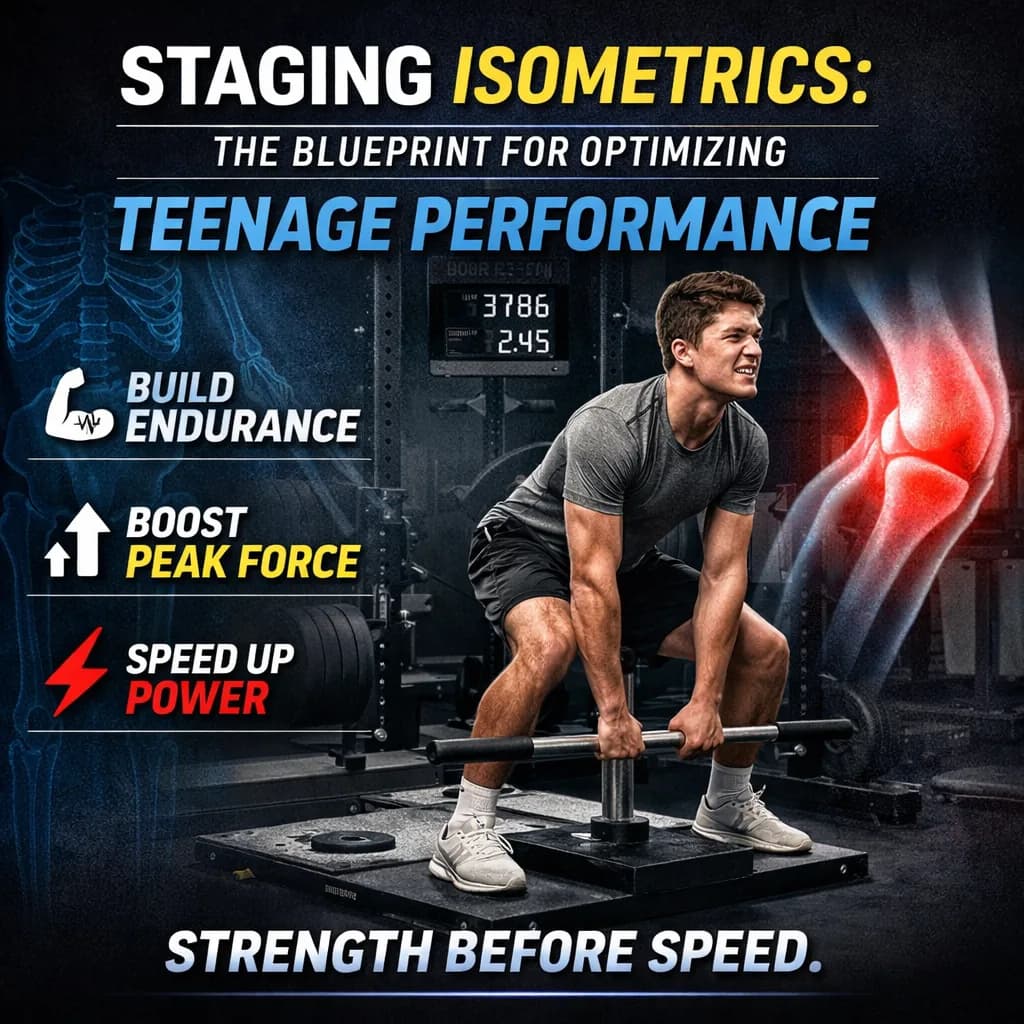
Force Without Coordination Is Injury Waiting to Happen
Strength is not a muscle problem, it is a neural one. This article explains why whole-body isometrics train coordination, stability, and force transfer at the nervous system level where performance is decided.
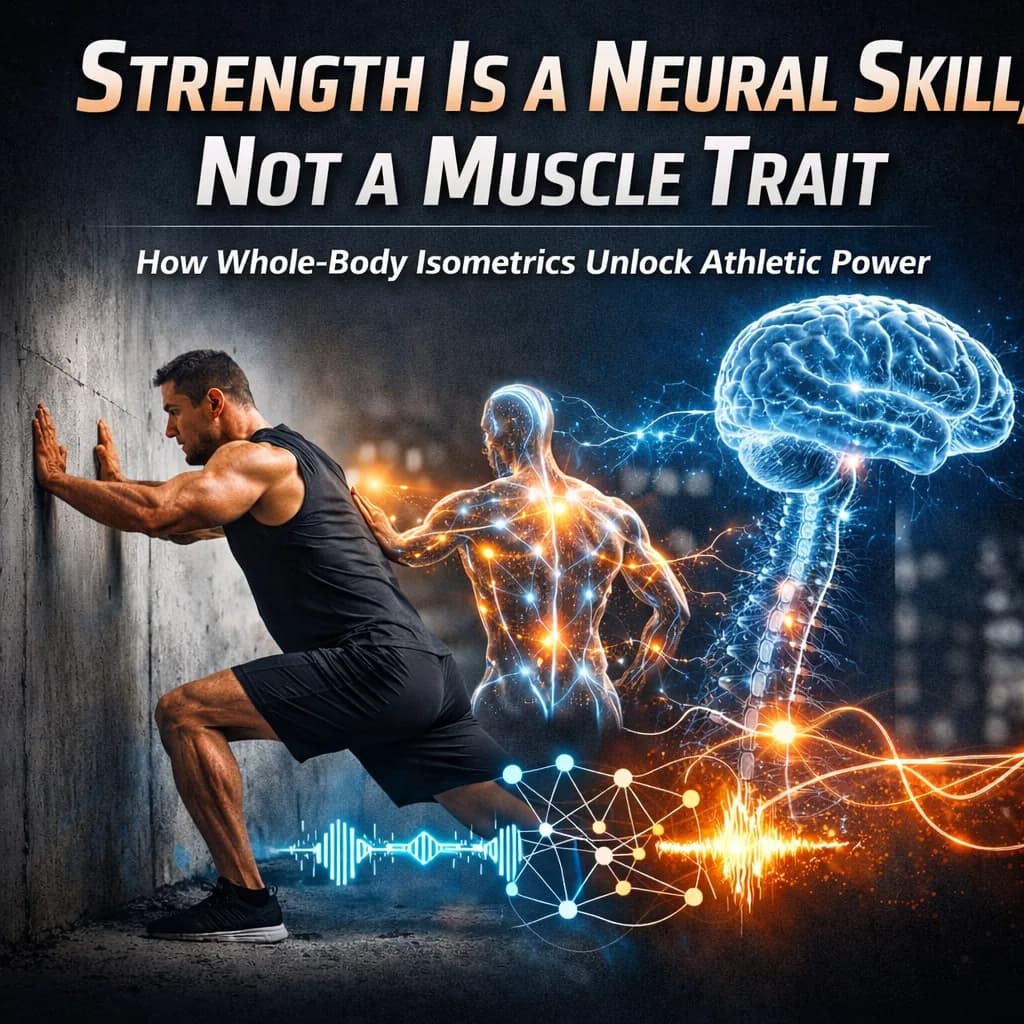
Why Athletes Need Whole-Body Isometric Training
In high-performance sport, athletes almost never fail because their muscles are weak. They fail because their nervous system cannot organize force fast enough, precisely enough, or efficiently enough when pressure hits.
Two athletes can lift the same load or hit the same sprint speed, yet one moves with effortless control while the other leaks energy, destabilizes under fatigue, and breaks down over time. That difference is not muscular. It is neurological.
Strength is not just about how much force you can create. It is about how cleanly your nervous system can coordinate that force across the entire body.
Strength Is a Neural Event First
Human movement is driven by muscle synergies, groups of muscles wired to activate together as a functional unit. These synergies allow the body to stabilize joints, transfer force, and react to unpredictable demands without conscious effort.
Recent neuroscience has clarified something critical:
synergies are governed by frequency-specific neural communication.
When athletes produce isometric force, muscles that belong to the same synergy receive synchronized neural signals. These signals operate in specific frequency bands responsible for spinal-level force regulation and cortical precision. Lower frequencies establish raw force output, while higher frequencies refine timing and coordination.
In simple terms, the nervous system does not just turn muscles on.
It orchestrates them.
Athletes with stronger neural coherence across synergies move more efficiently, stay stable under stress, and maintain performance as fatigue rises.
The Brain Reorganizes Under Isometric Load
Supporting evidence from brain-imaging research shows something even more revealing. As isometric force demands increase, the brain reorganizes itself into a more efficient and interconnected network.
Instead of fragmenting under effort, the brain increases cooperation between regions. Communication becomes tighter. Processing becomes more economical.
Force production is not a local muscular task.
It is a whole-brain coordination problem.
The harder the isometric demand, the more the nervous system upgrades its internal wiring to meet it.
Why This Matters in Sport
On the field, force happens fast and globally.
Cutting at speed.
Absorbing landings.
Throwing.
Accelerating.
Taking contact.
Each of these actions requires dozens of muscles across the ankle, knee, hip, pelvis, trunk, shoulder girdle, and cervical spine to coordinate within milliseconds.
Stability is not created at a single joint.
It is orchestrated across the entire kinetic chain.
When synergy timing is even slightly off anywhere in that chain, force leaks occur. Stress amplifies. Injury risk rises.
This is why most non-contact injuries are not failures of strength.
They are failures of coordination under load.
Why Dynamic Training Is Not Enough
Dynamic training absolutely matters. Speed, power, and elasticity all depend on it. But dynamic movement introduces variables that blur neural precision.
Momentum.
Elastic recoil.
Rapid joint-angle changes.
These factors inject mechanical noise into the system. That noise makes it harder for the nervous system to generate the clean, synchronized neural signals required for precise synergy behavior.
Isometric loading removes the noise.
With motion stripped away, the nervous system can focus purely on coordinating force. Timing becomes clearer. Neural drive becomes cleaner. Synergy coherence improves.
This is something dynamic training simply cannot replicate.
The Case for Whole-Body Isometrics
Muscle synergies do not operate in isolation. They span joints and regions.
Training one muscle or one joint at a time misses the point.
A whole-body isometric approach challenges the nervous system to coordinate force across the entire kinetic chain simultaneously. High-intensity isometrics impose a pure neural demand. There is no help from inertia. No assistance from motion. No shortcuts.
The nervous system must organize, sustain, and refine force with precision.
This directly strengthens the frequency-specific neural circuits responsible for stability, coordination, and resilient force transfer.
The Neurological Foundation of Durable Performance
If synergy behavior defines performance, and synergy behavior is trainable, then the training method that best targets synergy pathways becomes foundational.
High-intensity, position-specific isometrics do exactly that.
They prepare the nervous system to generate force.
To tolerate force.
To transfer force.
To express force efficiently when it matters most.
This is not supplemental work.
It is structural work for the nervous system.
Athletes who integrate whole-body isometrics do not just get stronger. They move cleaner, resist breakdown, and sustain performance over longer careers.
They win more.
They hurt less.
They age stronger.
And it starts by training strength where it actually lives: in the nervous system.

Your Strongest Position Might Be Your Biggest Blind Spot

The Science Behind Why Your Workouts Are Not Changing Your Body